
Wallet Node
The Onchain Infrastructure for Institutional Wallet Operations
Wallet Node runs execution, monitoring, and reconciliation for your institution's wallet,
across 70+ chains, under one enterprise SLA.








Financial institutions and digital asset businesses use Nodit infrastructure to support production services
NEEDS
Building a wallet and operating one at scale require different capabilities
Implementation needs speed and validation. Production needs reliable transactions, accurate balances, and audit-ready operations.
| DURING WALLET IMPLEMENTATION | DURING PRODUCTION OPERATIONS | |
|---|---|---|
| BUSINESS & IT TEAMS | Define supported chains and traffic profiles · Validate architecture · Run load tests · Review internal control requirements | Operate high-volume deposits and withdrawals · Resolve customer issues · Maintain balance integrity · Support close and audit processes |
| INFRASTRUCTURE | Chain connectivity · Archive/Trace access · Isolated test environments · Region and private-network requirements | Guaranteed capacity · Automatic exclusion of lagging nodes · Failover · Hard-fork readiness · 24×7 monitoring |
| DATA | Pre-transaction simulation · Fee estimation · Counterparty identification · Policy validation | Finality status · Reorg correction · Deposit detection · Historical balances and fiat valuation data |
| WHAT WALLET NODE PROVIDES | Validate capabilities · Dedicated institutional clusters · Reference architecture review | Execute · Observe · Reconcile layers, supported by Assure enterprise operations |
THE PROBLEM
Wallet Failures Put Trust and Ledger Integrity at Risk
For institutional wallets, an RPC response isn't enough. What matters is finality, accurate balances, and the ability to explain and recover from failures.
Can we identify transactions likely to fail before execution and avoid unnecessary fees and operational loss?
Pre-execution simulation · Expected asset changes · Gas estimation · Revert reason analysis
If a signed transaction stalls, can we explain what happened to customers and operations teams?
Broadcast status · Pending nonce · Failure classification · Duplicate-submission tracking
If a completed transaction is affected by a reorg, can we correct the customer ledger quickly?
Confirmation depth · Block lag · Reorg detection · Correction events
If an onchain deposit occurred but the customer balance was not updated, can we identify where the gap happened?
Native · Token · Internal Transfer detection · Webhooks · Block-level reconciliation
If the internal ledger and onchain balance diverge, can we locate the missing interval and reconcile it?
Point-in-time balances · Multi-address queries · Historical transaction evidence
Can we reproduce historical transactions and valuations for financial close, tax, or external audit?
Archive access · Transaction-time fiat valuation · Retained audit evidence
PRODUCT
Manage the Wallet Operations Lifecycle, from Validation to Reconciliation
Wallet Node organizes the wallet transaction lifecycle into four operating layers, from architecture validation to incident response, reconciliation, and audit.
Validate
Simulate a transaction before execution to verify the expected result, projected asset movement, and estimated cost.
- Simulation
- Gas Estimation
- Revert Reason
- Address Screening
Execute
Reliably broadcast signed transactions to the network while controlling nonce state, duplicate submission, and execution failures.
- Broadcast
- Pending Nonce
- Failure Classification
- Mempool Subscription
Observe
Track block inclusion, execution result, confirmation depth, and the impact of chain reorganizations in real time.
- Status Events
- Block Lag Monitoring
- Reorg Correction
- Deposit Webhooks
Reconcile
Reconstruct balances, deposits and withdrawals, internal transactions, and fiat-denominated values at historical points in time.
- Portfolio
- Internal Transactions
- Multi-address History
- KRW Valuation
Assure
Guarantees the infrastructure availability and operational responsibility production workloads need.
- Dedicated Clusters
- Korea Region
- Sync-Aware Routing
- Automatic Failover
- Committed Throughput
- 24×7 Operations
- Usage and Request Logs
Wallet Node Architecture
Institution · Key vendor
Wallet backend
MPC · HSM · KMS
Ledger · ERP · Audit
Assure
Dedicated infra · Korea region · Sync-aware routing · Auto failover · Committed RPS · 24×7 ops · SLA · Request logs
Data API
Four operational data layersValidate
Execute
Observe
Reconcile
Asset Grid
Indexed data setsPortfolio
Market Data
Screening
Events
Node Plane · 70+ chains
Direct chain accessJSON-RPC
WebSocket
Hypernode
Dedicated · Archive
Public blockchains
EVM Networks
Mempool
Blocks
WHO IT IS FOR
Infrastructure for Institutions That Need Control Over Wallet Operations
Expand node operations and onchain data capabilities without replacing your existing key-management architecture. Regulated financial institutions, digital asset businesses, and infrastructure providers can combine the functions and SLA profile their operating model needs.
Banks and Fintech Platforms
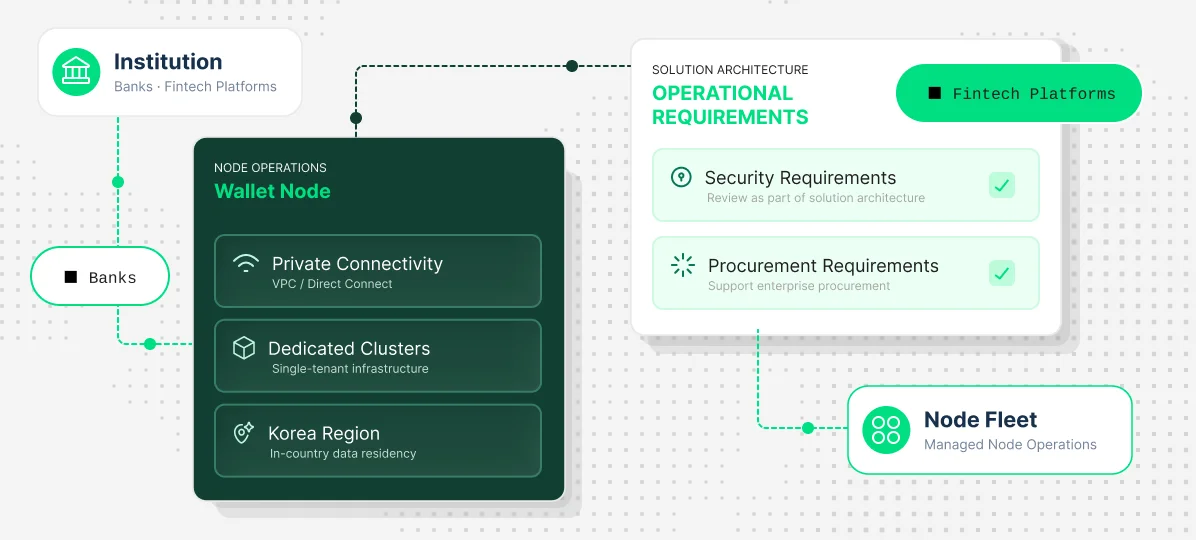
Launch digital asset wallet services without building a separate node operations team for every blockchain. Korea-region deployment, private connectivity, dedicated clusters, and other procurement or security requirements can be reviewed as part of the solution architecture.
- Assure
- Observe
- Node Fleet
- Korea Region
- Private Connectivity
Digital Asset Exchanges and OTC Brokerage
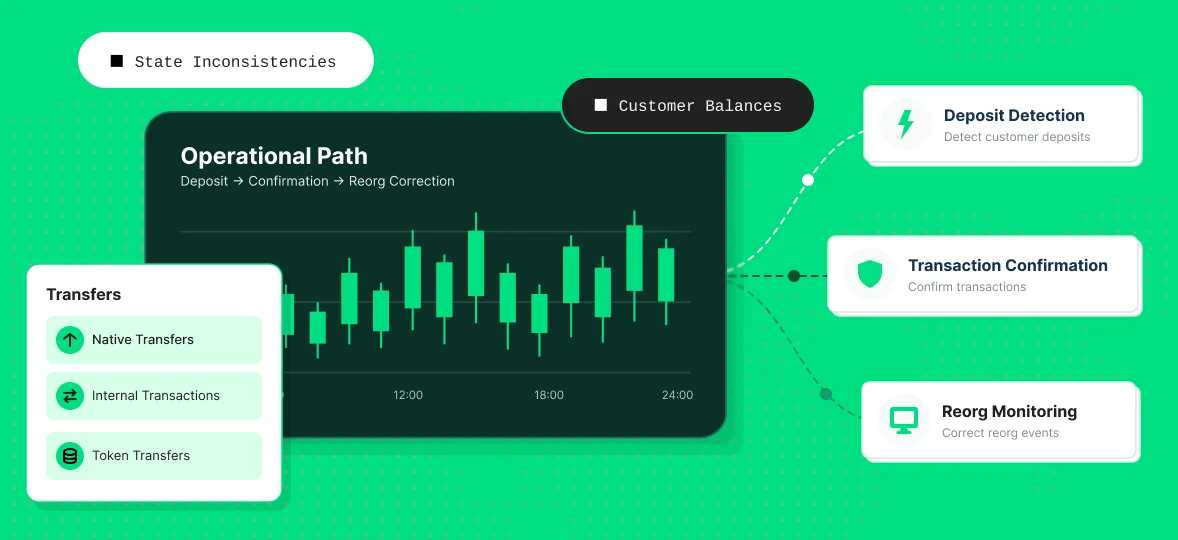
Track the operational path that directly affects customer balances — from deposit detection and transaction confirmation to reorg correction. Native transfers, token transfers, and internal transactions can be monitored together to identify missing events and state inconsistencies faster.
- Execute
- Observe
- Mempool Subscription
- Reorg Correction Events
Treasury and Digital Asset Managers
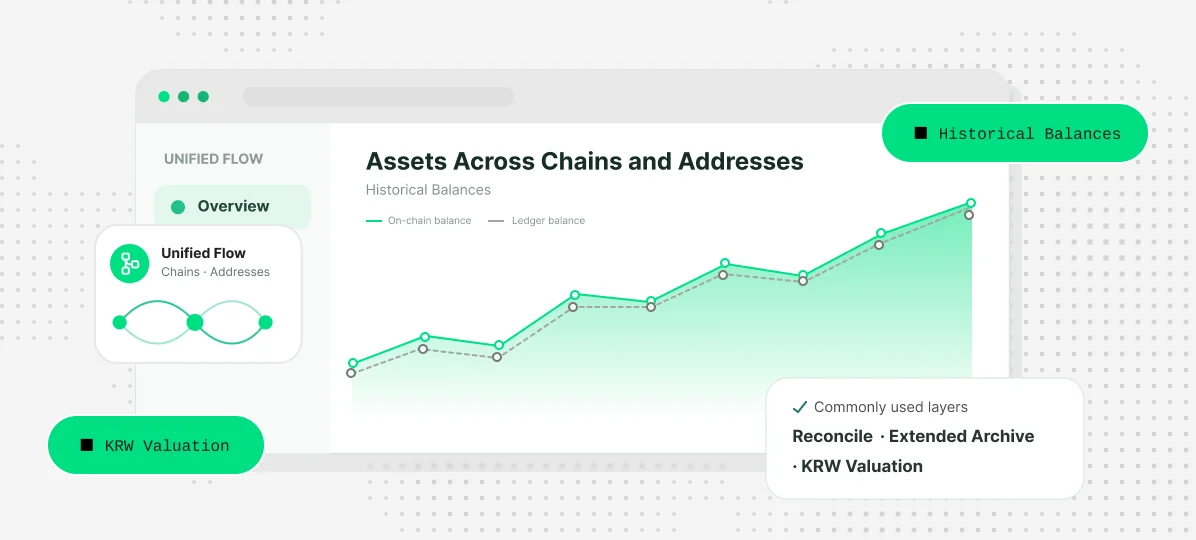
View assets distributed across chains and addresses in a unified flow, and reproduce historical balances and KRW-denominated valuations for reconciliation, financial close, and audit.
- Reconcile
- Extended Archive
- KRW Valuation
Custodians and B2B Infrastructure Providers
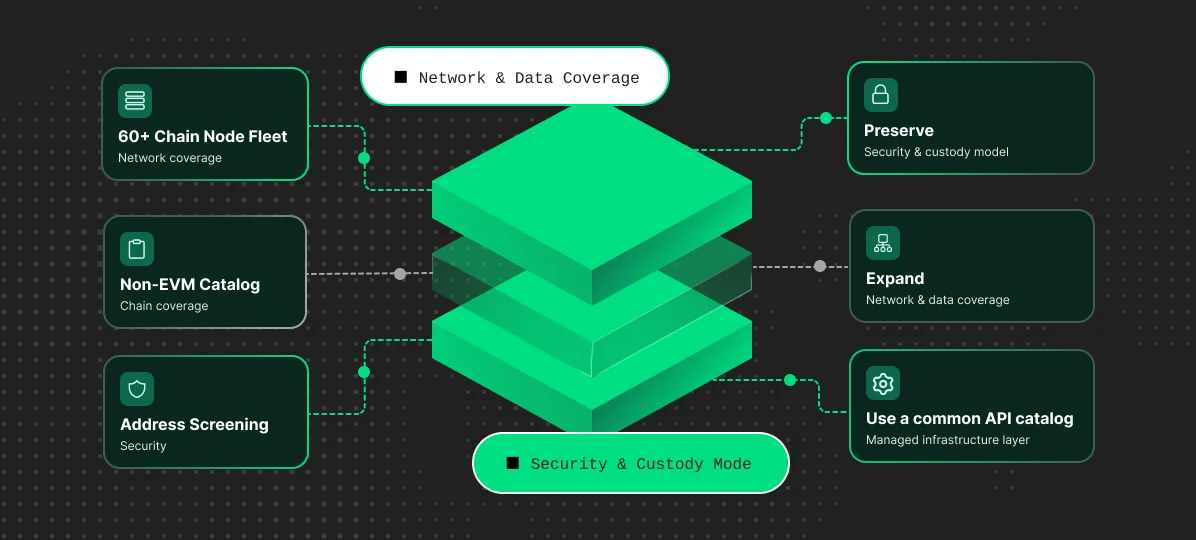
Preserve your security and custody model while expanding network and data coverage. Instead of rebuilding your operating model for each new chain, use a common API catalog and managed infrastructure layer.
- 70+ Chain Node Fleet
- Non-EVM Catalog
- Address Screening
Who uses Wallet Node inside an institution?
- IT & Infrastructureoutsource node operations while retaining control
- Move hard-fork handling, patching, and overnight incident response into a managed service while independently monitoring metrics such as Block Lag
- Service Operationsresolve customer inquiries with evidence
- Distinguish where a transaction is delayed and why a deposit was not reflected, using observable transaction and event state
- Finance & Accountingkeep internal ledgers aligned with onchain balances
- Trace ERP-to-chain balance differences and reproduce point-in-time balances and valuations for close, tax, and audit
- Compliancerecord review and audit evidence
- Use address and transaction data as first-line inputs to internal review workflows and retain query and processing history for audit support
BUSINESS BENEFITS
Shift Infrastructure Risk to Managed Operations with SLAs
Instead of owning every aspect of chain infrastructure, institutions can define an explicit operating scope with Wallet Node and allow internal teams to focus on customer experience, controls, and business operations.
| BUILDING IN-HOUSE | WITH WALLET NODE | |
|---|---|---|
| HIGH AVAILABILITY | Continuously manage sync status, failover, and disaster-recovery architecture chain by chain | Standardize failover with sync-aware routing and automated traffic switching |
| PERFORMANCE AND CAPACITY | Re-size infrastructure and tune peers whenever traffic grows | Secure required capacity through dedicated clusters and committed throughput |
| CHANGE MANAGEMENT | Handle hard forks, client upgrades, and emergency patches during nights and weekends | Include network monitoring and node upgrades in the managed operating scope |
| DATA INTEGRITY | Implement reorg, finality, and archive-recovery logic independently for each chain | Use shared logic for status handling, reorg correction, and re-indexing |
| ENTERPRISE SECURITY AND CONNECTIVITY | Design region, network segmentation, and private access patterns separately | Support Korea-region deployment, Direct Connect, VPN, and IP allowlisting where required |
| OBSERVABILITY AND INCIDENT RESPONSE | Build chain-specific dashboards and alerts, then investigate root cause internally | Simplify Response with 24×7 Monitoring and RCA Support |
| BUSINESS SCALABILITY | Add infrastructure and operations resources each time a new chain is introduced | Expand chain coverage through a common operating model and API catalog |
COMPETITIVE ADVANTAGE
High-availability nodes, dual-ledger connectivity, and audit-ready evidence for institutional digital asset operations.
The difference is not an abstract claim of being "enterprise-grade." Wallet Node is designed around the operating requirements of institutional wallet services — requirements that general-purpose RPC services may not provide as one managed stack.
| GENERAL-PURPOSE GLOBAL NODE PROVIDERConnectivity, on Shared Infrastructure | NODIT WALLET NODEOperational Outcomes, Under One Enterprise Service | |
|---|---|---|
Broad Chain Coverage on Shared Infrastructure | CHAIN SUPPORT | 70+ chains with infrastructure under direct operational control, including dedicated deployment options |
Successful API/RPC Response | DEFINITION OF SUCCESS | Ability to verify block inclusion, execution result, and confirmation state |
Server Health or Ping Response | ROUTING SIGNAL | Routing based on chain synchronization freshness, with Block Lag metrics available for independent monitoring |
Shared Capacity, Often Best-Effort by Plan | THROUGHPUT MODEL | Dedicated clusters and committed throughput (RPS/CU) defined for institutional deployments |
Public Global Regions and Internet-Based Access | REGION AND CONNECTIVITY | Korea region · Direct Connect · IPSec VPN · IP allowlisting options |
Native and Token Support Varies by Network and Plan | DEPOSIT-DETECTION COVERAGE | Native · Token · Internal Transfer coverage with secure event-delivery options such as mTLS |
Current chain state reflected at query time; correction signals may require custom handling | REORG HANDLING | Correction events can propagate identifiers, sequence information, and dropped-state markers to institutional systems |
Archive Depth and Retention Vary by Provider | HISTORICAL ACCESS | Historical access and retention scope can be defined as part of the enterprise service |
Often Focused on Current Market Price | FIAT VALUATION | Support for reproducible transaction-time KRW valuation workflows |
Chain-Specific Raw RPC Integration | NON-EVM INTERFACE | Bitcoin · Solana · Aptos · XRPL · Tron provided through a common catalog approach alongside EVM networks |
Usage-Based API Credits | COMMERCIAL MODEL | Enterprise agreement covering node infrastructure · data services · SLA |
| What the vendor typically covers | What production wallet operations still require — provided by Wallet Node | |
|---|---|---|
| Key Management (KMS) · Custody Solution | Internal approval policy · multi-signature workflows · private-key isolation | Node infrastructure and the onchain operational data required for reconciliation; Nodit can participate alongside key-management and integration partners in a joint project model |
| WaaS API with signing | Key creation and signing interfaces · standardized transaction objects | Onchain-level evidence and operational data that remain available independently of the signing layer |
| Blockchain data API | Read-oriented balances · history · portfolio views | Transaction execution infrastructure · mempool monitoring · isolated institutional environments · clearly defined operational responsibilities |
| Data warehouse | Historical analytics · onchain metrics · bulk datasets | Large-scale datasets via Nodit Datashare (add-on) · runtime API operations · event-delivery workflows · reorg-aware data handling |
| Dedicated node hosting | Isolated compute capacity and deployment control | An indexing layer that turns raw chain data into wallet-operational data such as balances, Internal Transfers, and point-in-time valuations |
| Nodit Wallet Node | Combines dedicated node infrastructure across 70+ chains with indexed operational and reconciliation data under a single enterprise service model | Designed to cover the environment production wallet operations depend on. It is designed to work alongside an institution's existing key-management vendor or SI partner rather than replace them. |
CRITICAL CAPABILITIES
The Capabilities Institutions Rely on Most in Production
Institutional wallets are not differentiated by API count, but by whether risk is caught before execution and ledgers stay aligned with the chain.
Transaction Simulation
Inspect expected results, revert reasons, gas, and asset changes before submitting — likely failures are filtered and policy checks run before assets move.
- Pre-check execution success
- Revert reason analysis
- Expected gas and fee
- Expected asset changes
Transaction & Deposit Monitoring
Follow a signed transaction from network entry through Pending · Mined · Confirmed to deposit recognition. State stays visible through ledger impact, not just delivery.
- Pending nonce and ordering
- Stuck
- Dropped
- Replaced
- Internal Transfer deposits
- Gap backfill
- Dedicated mTLS channels
Unified Asset & Transaction Data
Portfolio, token transfers, Internal Transactions, and multi-address history in one layer — customer balances, operational tracking, and finance reconciliation read the same onchain data.
- Address-level assets
- Unified transaction history
- Multi-address
- multi-chain
- Historical state reconstruction
- Ledger reconciliation
Native Token Pricing
Retrieve native token prices in USD or KRW to convert onchain balances into fiat value. ETH, SOL, and BTC are evaluated through one workflow across networks.
- USD
- KRW pricing
- Fiat conversion of balances
- Customer portfolio value
- Treasury reporting
- Volume
- market capitalization
Address Screening
Enrich addresses and contracts with entity and category data so teams can read a counterparty before funds move. An address surfaces as Exchange or DEX Contract where data is available.
- Counterparty identification before transfer
- Address-type classification
- Entity display in address books
- Inputs for allowlist/blocklist policies
- Contract inference
Reorg Correction
A reorg can change transactions and balances already treated as complete. Wallet Node identifies the affected state and delivers IDs, sequence markers, and dropped-state signals so systems realign with the canonical chain.
- Reorg detection
- Changed or removed transactions
- Correction events
- Customer-balance reprocessing
Enterprise Address Monitoring
Per-address polling does not scale for exchanges, custodians, and platforms managing hundreds of thousands of addresses. Capacity and topology are designed around address count, event frequency, networks, and peak traffic.
- Continuous monitoring of large address sets
- Multi-network event processing
- High-volume deposit/withdrawal operations
- Address-group policies
- Dedicated throughput
- Dedicated data pipelines
ENTERPRISE CUSTOMIZATION
Custom Data Pipelines for Institutional Needs
Wallet Node starts with standard APIs and extends only where needed, adding institution-specific interfaces on top of a shared Node · Data · Event foundation.
What business workflow are you operating?
Define the target service, supported assets and networks, and deposit/withdrawal policy.
Which Networks and Data Are Required?
Assess chain characteristics, data scope, address volume, and peak traffic.
How should it connect to existing systems?
Design additional fields, event conditions, labels, data formats, and legacy integration.
What Needs to Be Extended?
Build Custom APIs, Event Pipelines, and Private Endpoints only where required.
Does it work under real operating conditions?
Validate transactions, deposits, reorg handling, and reconciliation against peak traffic.
How Is the Architecture Operated After Launch?
Manage node operations, data integrity, incidents, and network expansion in one model.
What Institutional Customers Ask Most
Production-Ready Architecture for Digital Asset Operations
We assess your target networks, transaction volume, and existing security stack to define the right deployment model. Wallet Node works with your existing KMS, HSM, custody, and SI partners — extending your architecture rather than replacing it.
Node infrastructure and onchain operations, unified across 70+ networks.
View Documentation