
Wallet Node provides the transaction APIs, onchain data, monitoring, and node infrastructure required to operate digital asset wallets.
TL;DRThe customer experience is simple: a user sends a digital asset and receives confirmation. Behind that experience, the institution must validate the transaction, submit it to the network, monitor execution and finality, and reconcile the result with internal records.Wallet Node packages the APIs, data, and node infrastructure repeatedly required across institutional digital asset projects. Existing wallet backends, MPC and HSM infrastructure, and ledger systems remain under institutional control — Wallet Node provides the on-chain infrastructure layer for transaction processing and production operations.The service is supported by redundant infrastructure, automatic failover, 24×7 operations, SLA coverage, and SOC 2 Type II controls, and is already deployed in production at major financial institutions.
One transfer for the customer. A full transaction lifecycle for the institution.
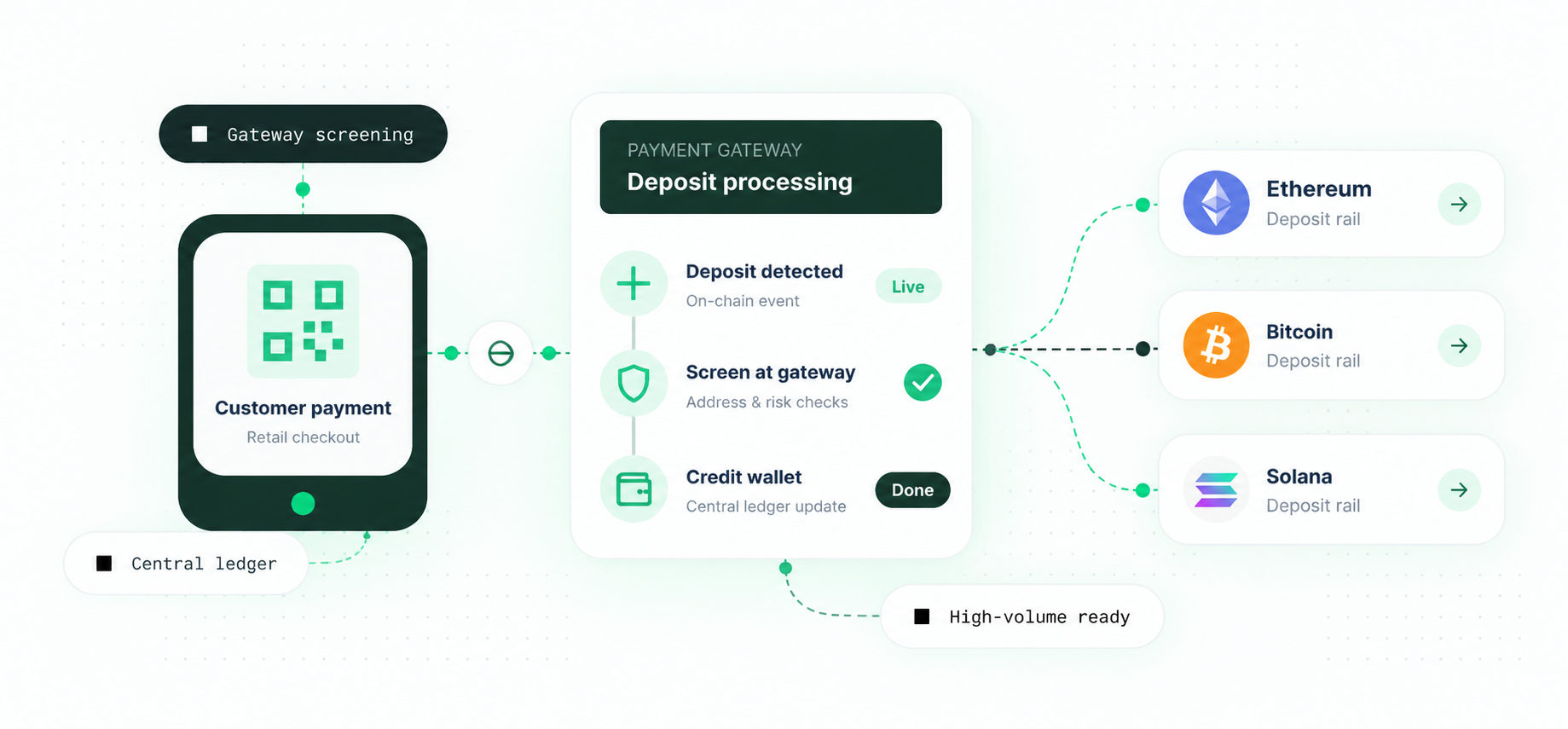
Customers should not need blockchain expertise to use a financial service built on blockchain infrastructure. A digital asset transfer should provide the same clarity customers expect from established financial applications: the customer selects a recipient, submits the transfer, and receives a clear transaction status. Network architecture, node conditions, confirmation requirements, and chain-specific behavior should remain within the infrastructure layer.
This matters most for financial institutions and fintech companies that already have established customer experiences. Introducing blockchain should not require customers to learn a new technical model. It should extend the infrastructure available to the service while preserving a familiar financial experience.
The operational requirements behind that experience are considerably more complex. Before a transfer is submitted, the institution needs to validate execution, estimate network fees, and verify available information about the destination. After signing, the transaction needs to reach an available and synchronized node. The institution then needs to monitor block inclusion, execution status, finality, and relevant network events. And the work does not end when the transaction confirms: the on-chain result must align with internal records, and the institution must be able to reconstruct that result for reconciliation and audit long after the fact.
For the customer, this is one transfer. For the institution, it is a complete on-chain transaction lifecycle, and Wallet Node provides the infrastructure for that lifecycle.
The wallet, keys, transaction policies, and internal ledger remain under institutional control. Existing Wallet Backend, MPC, HSM, KMS, Ledger, and ERP systems stay in place, and Wallet Node operates beneath them, providing the transaction, data, event, and node infrastructure required to connect them to public blockchain networks.
Your wallet and keys remain under your control. Wallet Node provides the on-chain infrastructure underneath.
Reduce the On-Chain Infrastructure Your Team Must Build and Operate
Financial institutions evaluating wallet infrastructure need to determine which capabilities should remain internal and which can be provided as managed infrastructure.
Operating a digital asset wallet can require separate systems for blockchain access, transaction validation, transaction monitoring, deposit and withdrawal detection, historical data, routing, failover, and operational logging. Each additional component introduces development work, and beyond that an ongoing operational responsibility: the system must be monitored, failures must be diagnosed, node synchronization must be checked, data pipelines must remain available, and network-specific behavior must be maintained as the service expands.
Wallet Node provides these capabilities through a managed infrastructure layer.
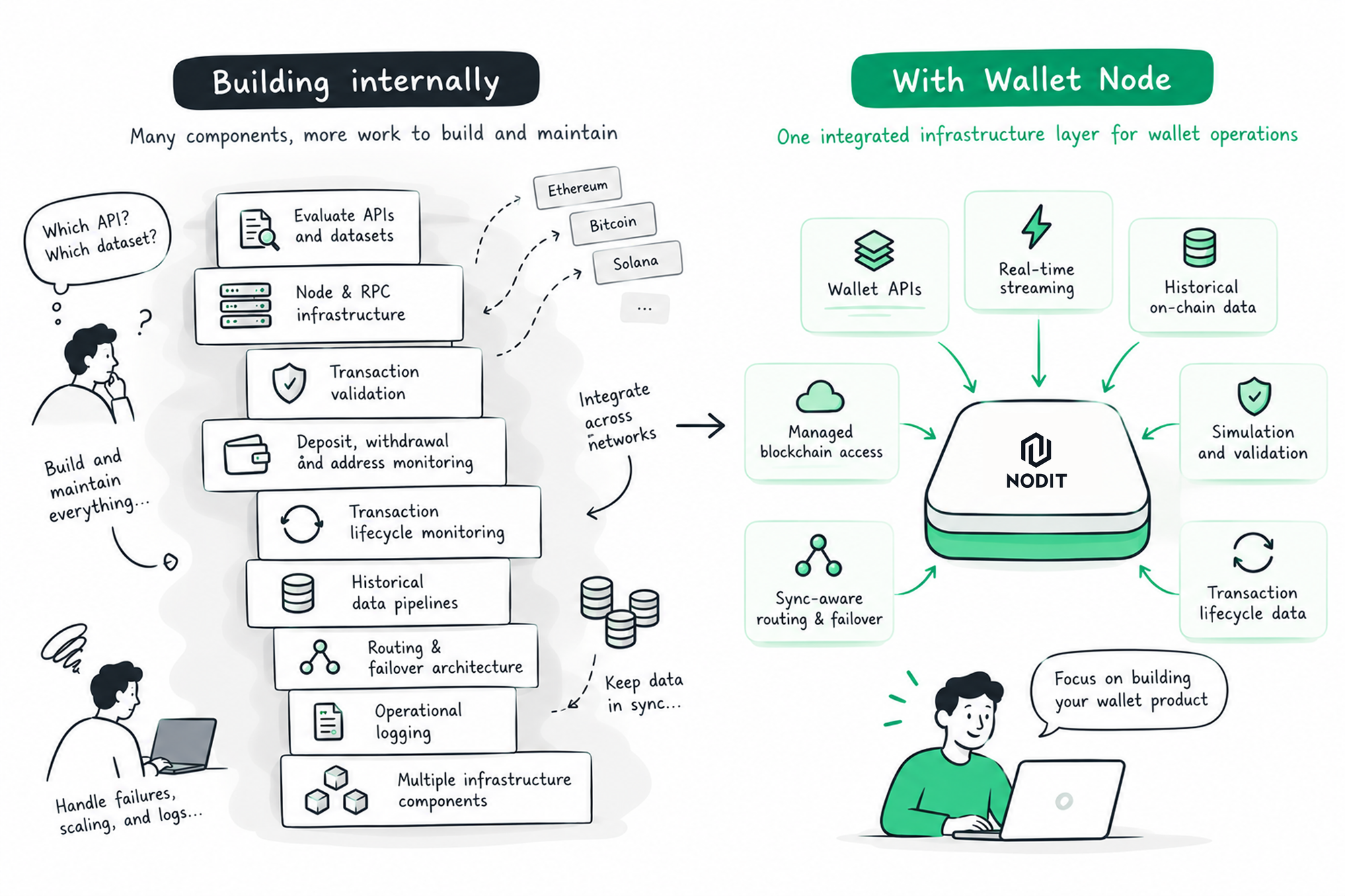
The objective is not to reduce the number of API calls. It is to reduce the amount of blockchain infrastructure that internal teams need to select, integrate, monitor, maintain, and troubleshoot in production.
Wallet Node does not replace the existing wallet stack. Wallet Backend, MPC, HSM, KMS, Ledger, and ERP remain under institutional control, and Wallet Node provides the infrastructure below those systems: transactions, data, events, and node infrastructure.
Built From Recurring Requirements Across Institutional Wallet Projects
The challenge in building a digital asset wallet is not simply finding an API. The more difficult question is determining which APIs, datasets, and infrastructure components the service actually requires: which node architecture should support the service, what should be validated before a transaction is submitted, how deposits and withdrawals should be detected, what level of confirmation represents finality, how historical balances and transactions should be retrieved, and how on-chain activity should connect to internal financial systems.
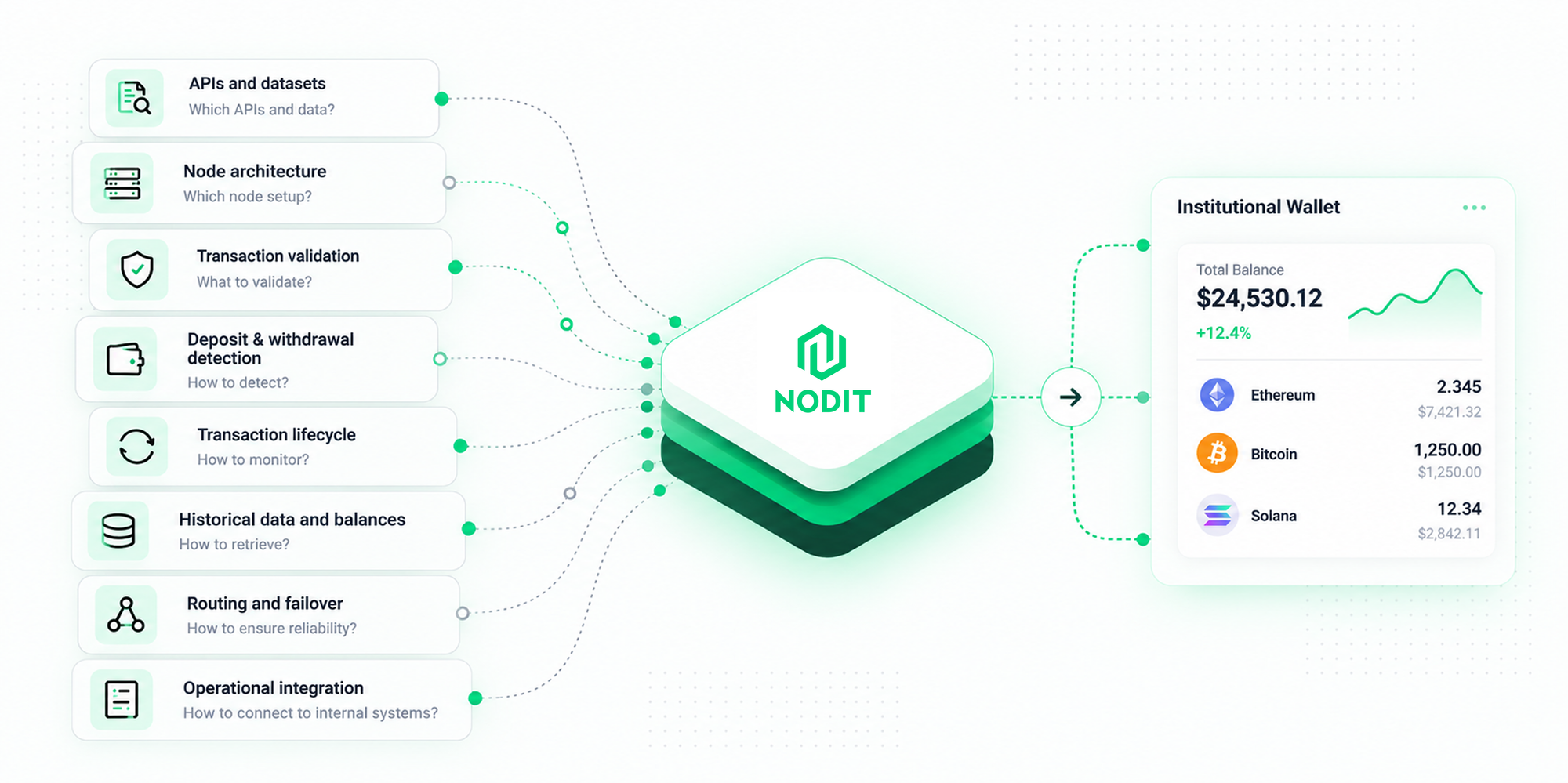
These questions have appeared repeatedly across digital asset projects with major financial institutions. The specific services varied, but the underlying infrastructure requirements were consistent.
Before submission —
- Can the transaction execute successfully?
- What network fee should be expected?
- What information is available about the destination address?
During submission —
- Which node should receive the signed transaction?
- What happens if a node is unavailable or out of sync?
- How should duplicate submissions be prevented?
After submission —
- Was the transaction included in a block?
- Did execution succeed? Has the required level of finality been reached?
- Can deposits and withdrawals be detected as they occur?
During settlement and close —
- Can the institution retrieve balances and transaction history for a specific point in time?
- Can on-chain records be reconciled with internal ledgers?
- Can previous transaction states and processing records be reconstructed?
Wallet Node was developed around these recurring requirements. It is not a generic collection of blockchain endpoints, but a package of transaction APIs, indexed data, event infrastructure, and node infrastructure organized around the operational requirements of digital asset wallets. This changes the starting point for a wallet team: instead of determining the required blockchain infrastructure component by component, the team can evaluate the Wallet Node capabilities required for its service model.
The Four Operational Stages of a Digital Asset Transaction
A wallet transaction can be viewed as four operational stages, each addressing a different requirement in the transaction lifecycle.
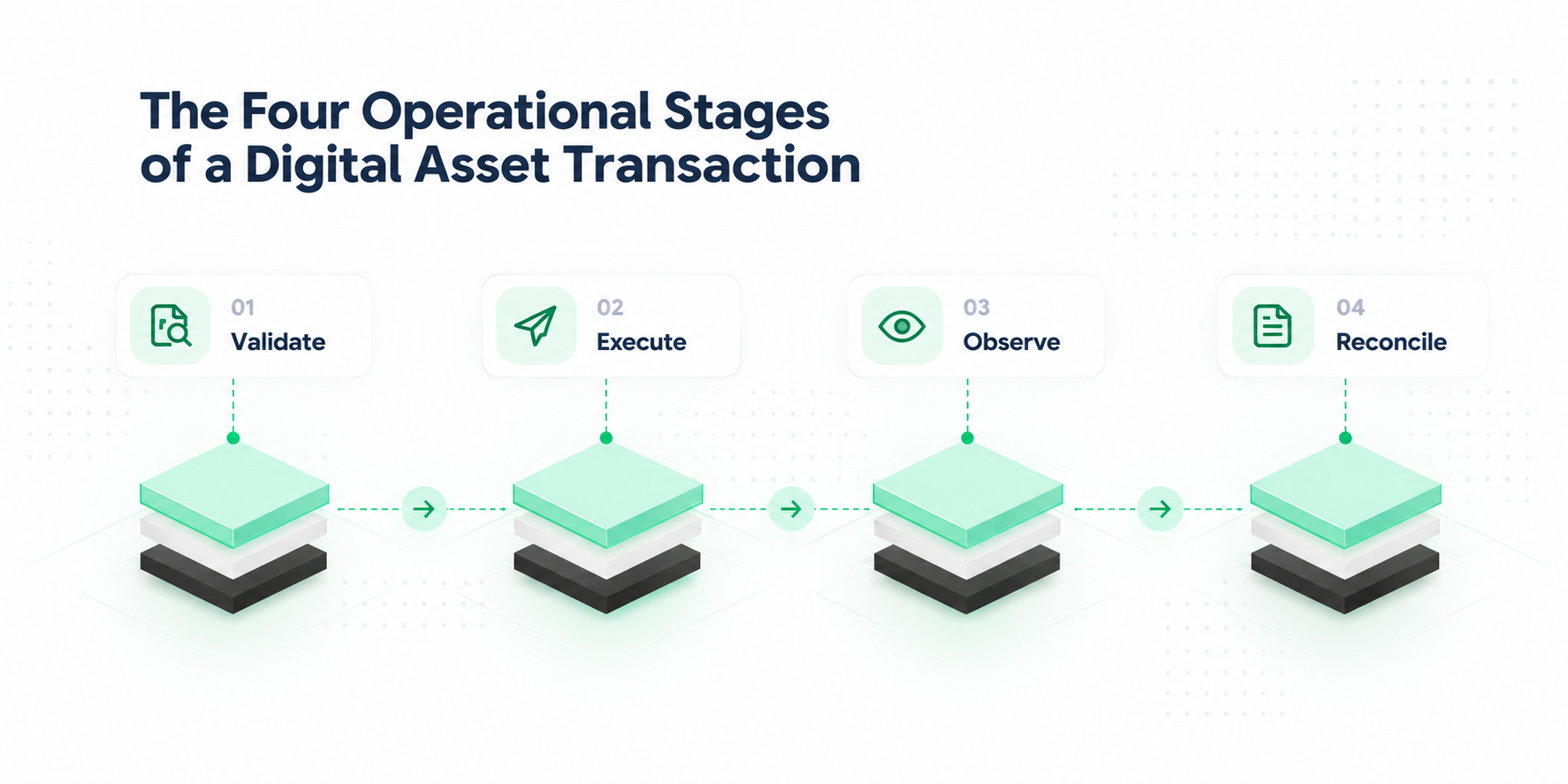
Validate — verify before value moves
Financial services need information before a transaction is submitted, not only after execution. Wallet Node provides transaction simulation, fee estimation, account labels, address categorization, and pre-submission validation, allowing wallet applications and internal approval systems to validate expected execution, estimate network costs, and add available context to destination addresses before value moves.
A blockchain address alone provides limited information to a customer or operations team. Where data is available, Wallet Node can add context about known addresses and contract categories, helping identify whether a destination is associated with an exchange, bridge, staking contract, or another recognized category. This information provides counterparty context; it does not replace sanctions screening, risk assessment, transaction monitoring, or investigation systems.
Transaction Simulation · Fee Estimation · Account Labels · Address Categorization · Pre-submission Validation
Execute — submit signed transactions reliably
A transaction signed through an MPC or HSM still needs to reach the blockchain through reliable infrastructure. Wallet Node provides signed transaction submission, routing, nonce handling, and deduplication. Node condition matters throughout this process: a node that is unavailable or behind the current network state can affect submission and the information returned to the wallet application, so the infrastructure needs to account for node availability and synchronization status when processing requests.
Signing, key management, and transaction authorization remain under institutional control. Wallet Node connects transaction submission to Nodit node infrastructure and routing, and provides the infrastructure required to submit the resulting signed transaction to the network.
Signed Transaction Submission · Routing · Nonce Handling · Deduplication
Observe — track transactions through confirmation
Transaction submission does not represent transaction confirmation. After submission, the wallet needs to determine whether the transaction was included in a block, whether execution succeeded, and whether the required level of finality has been reached, and relevant network events can still change the observed state. Wallet Node provides the data and event infrastructure required to monitor transaction results, finality, reorg-related events, and other changes in on-chain state.
Deposit and withdrawal monitoring follows the same principle. Instead of requiring the wallet backend to continuously inspect blocks for activity associated with customer addresses, Webhooks and real-time streams connect relevant on-chain events directly to service logic. This allows the application to distinguish between a transaction that has been submitted and one that has reached the confirmation state the service requires.
Transaction Result · Finality · Reorg Handling · Webhooks · Real-time Streams
Reconcile — connect on-chain activity to financial records
Transaction confirmation does not complete the operational process for a financial institution. On-chain activity needs to connect to the financial records the institution maintains: customer balances need to align with internal records, deposits and withdrawals need to map to the corresponding on-chain transactions, and settlement and close processes may require historical information rather than only the current blockchain state. The same requirement applies when an institution needs to reconstruct a previous transaction or balance.
When an auditor asks why a customer balance had a specific value at a specific point in time, the institution needs data that can reconstruct and explain that state. This requires more than the current balance. The institution may need the relevant on-chain state, transaction history, valuation information, processing records, and the corresponding entry in the internal ledger.
Wallet Node provides indexed data for wallet operations, including balances, transfers, and historical state, while transaction-time valuation data and request and processing records support reconciliation, financial close, and audit workflows.
Balances · Transfers · Historical Data · Transaction-time Fiat Valuation · Request and Processing Logs
These capabilities support the flow from on-chain activity into internal financial processes: On-chain Activity → Ledger → ERP → Reconciliation → Audit. A standard RPC interface primarily provides access to blockchain state, whereas an institutional wallet also needs to determine how that state connects to internal financial records. Wallet Node therefore extends beyond node access to include the data and operational infrastructure required for reconciliation workflows.
Applied Across Institutional Wallet Operations
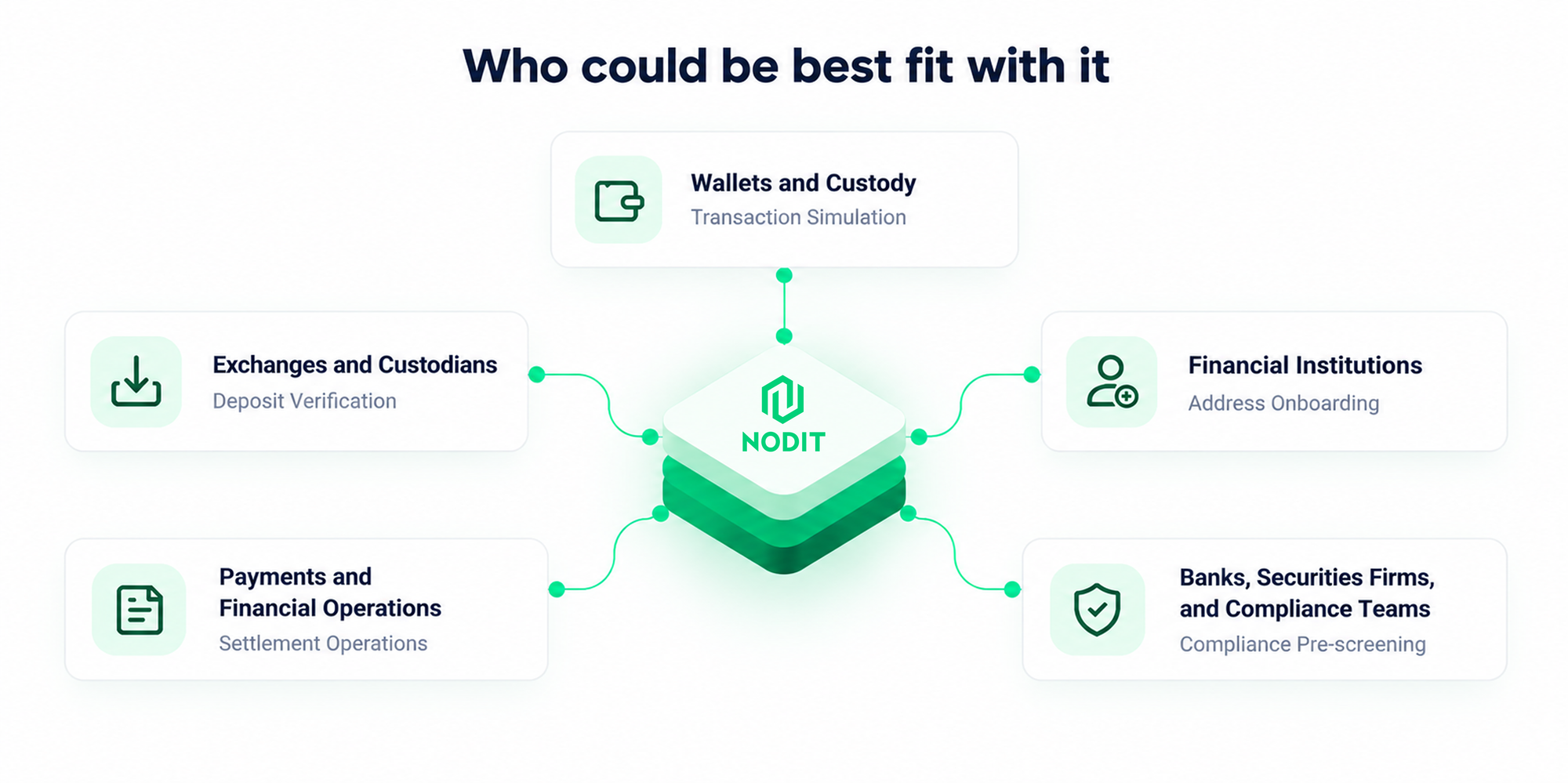
Wallet Node supports customer-facing applications as well as internal operational systems, and the same infrastructure can be applied at different points in the wallet lifecycle.
- Before Send (Wallets and Custody)
Simulate transactions, estimate network fees, and provide available context about destination addresses before transaction approval.
- Deposit Verification (Exchanges and Custodians)
Detect incoming deposits, monitor confirmation status, and connect relevant address and transaction information to operational workflows.
- Address Onboarding (Financial Institutions)
Add available on-chain context and address categorization to address registration, onboarding, and verification processes.
- Settlement Operations (Payments and Financial Operations)
Connect on-chain transaction activity with internal records and provide the historical data required for reconciliation and settlement workflows.
- Compliance Pre-screening (Banks, Securities Firms, and Compliance Teams)
Provide foundational address and transaction context before dedicated compliance screening or investigative processes.
Wallet Node provides the underlying on-chain information. Dedicated compliance systems remain responsible for sanctions screening, risk assessment, and investigation.
Infrastructure Engineered for Production Continuity
Financial institutions need to evaluate blockchain infrastructure under both normal and failure conditions. A node that falls behind, an unavailable endpoint, or an interrupted data service can affect transaction processing, withdrawal operations, balance presentation, and internal operations. Production infrastructure therefore requires more than blockchain connectivity: it requires redundancy, node-state awareness, routing, failover, monitoring, operational support, and traceability.
Wallet Node is supported by infrastructure designed around these requirements. Redundant infrastructure provides alternate capacity when an individual component becomes unavailable, and sync-aware routing takes node synchronization status into account when selecting infrastructure to process a request. Automatic failover routes requests through alternate paths when a component becomes unavailable, while committed throughput supports predictable production capacity. Around these, 24×7 operations support continuous production environments and incident response, SLA coverage provides a defined operational framework, and request-level logging provides traceability for investigation and support.
These capabilities operate as one infrastructure model:
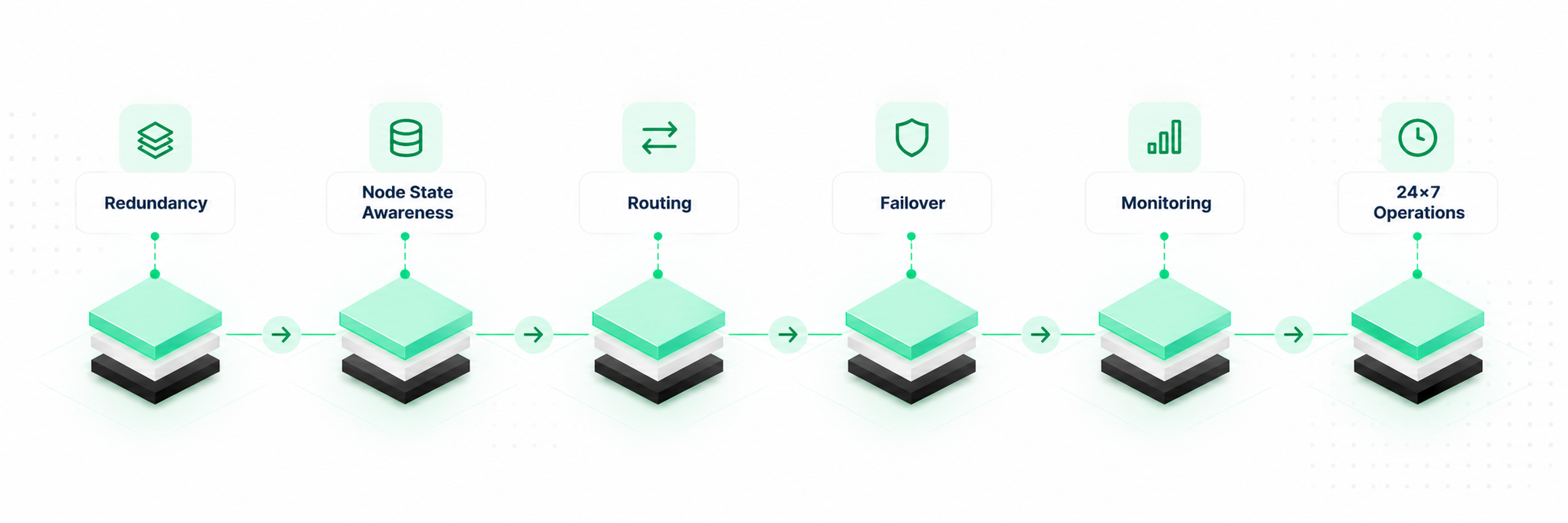
The objective is service continuity under real production conditions, including conditions in which individual components can fail. Wallet Node is supported by Nodit node and data infrastructure, SOC 2 Type II controls, and multi-chain coverage.
Proven in Production With Major Financial Institutions
Wallet Node was developed from recurring requirements identified across institutional digital asset projects, including transaction simulation, reliable blockchain access, real-time deposit and withdrawal monitoring, historical on-chain data, transaction lifecycle monitoring, and integration with internal financial systems. The result is an infrastructure package designed around the operational requirements that repeatedly appear when financial institutions build and operate digital asset wallets.
Wallet Node is currently deployed in production environments at major financial institutions. Customer deployments and use cases will be introduced as they become available for public disclosure.
Define the Operating Model Before the Infrastructure
Planning a digital asset wallet starts with the operating model. The first questions are not which API provider to select or which endpoint to integrate, but how the service will operate: Who controls the assets and keys? Who authorizes and signs transactions? Which networks and assets will the service support? What transaction flows will it need, and what level of confirmation will each workflow require? How will deposits and withdrawals be monitored, and what historical data will settlement, reconciliation, and audit processes require? What operational requirements will apply after launch?
The answers determine the node, API, data, event, and operational infrastructure the service requires.
The custody model is part of this architecture. Custodial and non-custodial wallet models establish different requirements for key control, transaction authorization, operational responsibility, and system architecture, and regulatory and licensing requirements depend on jurisdiction and the specific service structure and require separate assessment. Wallet Node does not determine the custody model and does not replace the systems responsible for custody or key management. It provides the on-chain infrastructure beneath the selected operating model.
For institutions already operating digital asset wallets, Wallet Node can also support infrastructure expansion, including adding networks, reducing the operational scope of existing RPC and data infrastructure, extending transaction monitoring, or supporting reconciliation requirements.
About Nodit
Nodit is an enterprise-grade blockchain infrastructure platform providing reliable node access and consistent on-chain data for digital asset services. Across 70+ networks, Nodit combines managed node infrastructure, standardized data processing and delivery, DataShare with specialized blockchain datasets, and Validator-as-a-Service (VaaS) to support production-scale operations, institutional analytics, and AI applications.
Backed by SOC 2 Type II and proven experience with major regulated exchanges worldwide, Nodit provides the complete on-chain data pipeline that powers the digital asset economy.