
Through its partnership with Fund Connect HK, Nodit provides participating teams with access to on-chain data infrastructure for digital asset research and monitoring.
TL;DR
- Nodit joins as a data partner of the 2026 Hong Kong Quant Trading Championship.
- Participating teams can apply for service credits for on-chain data access, real-time monitoring and AI-assisted research.
- Nodit supports quant research and risk monitoring, helping teams spend less time maintaining data infrastructure and more time testing strategies.
On-chain data is an important resource for digital asset research and risk management. Wallet balances, token transfers and smart contract activity provide visibility into asset movements and network activity, complementing conventional market data. Institutional research publications, including Fidelity Digital Assets’ quarterly Signals Report, incorporate on-chain metrics into their analysis.
Integrating this data into operational workflows requires infrastructure for retrieval, indexing and event delivery. Research and risk teams need consistent access to relevant information, whether they are investigating a market hypothesis, monitoring portfolio wallets or reviewing changes in exposure.
Nodit supports these requirements through managed blockchain infrastructure, indexed data APIs and event monitoring tools.
Supporting Quantitative Research Through the Fund Connect HK Partnership
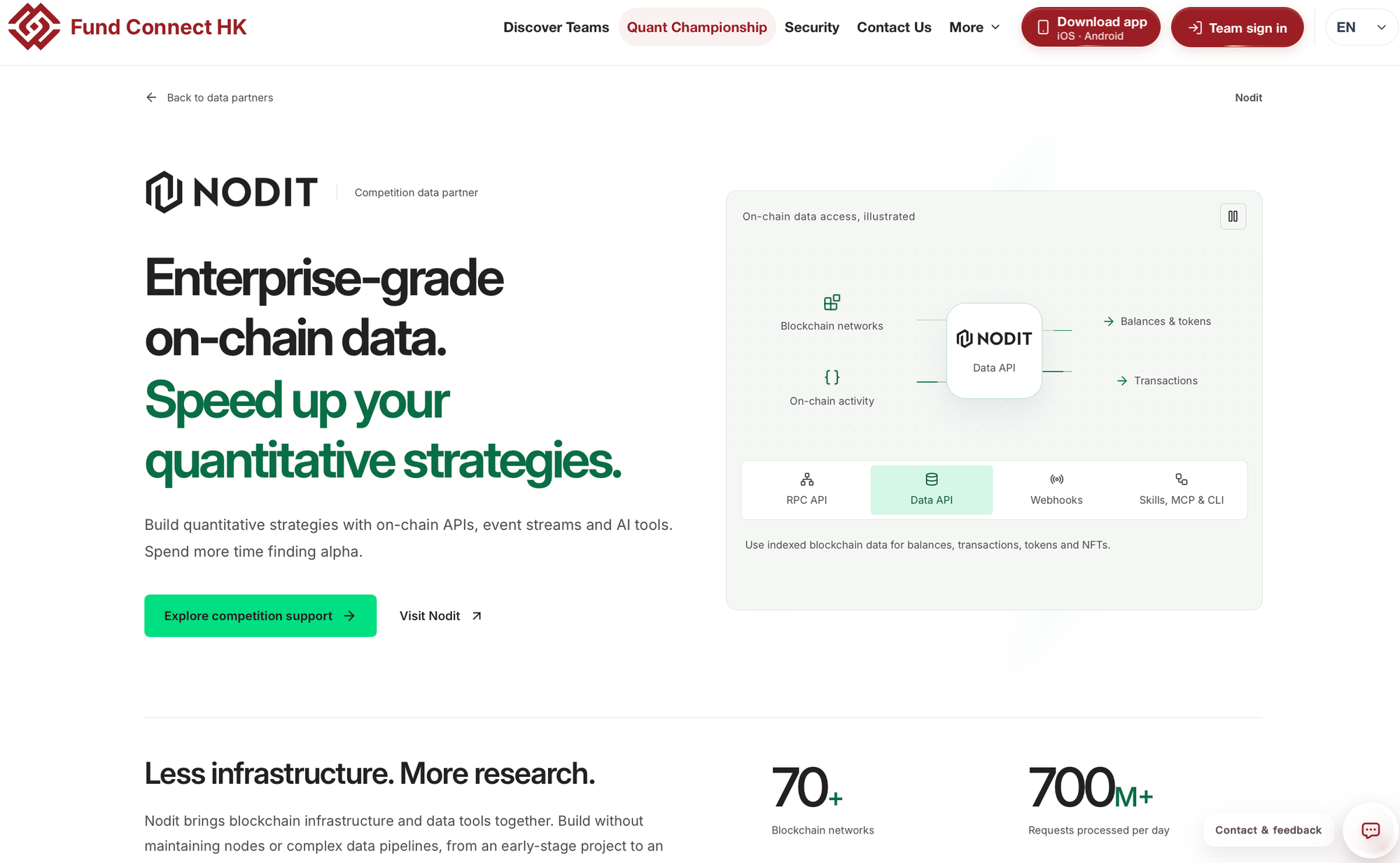
Nodit is a data partner of the 2026 Hong Kong Quant Trading Championship, organized by Fund Connect HK . The championship is open to researchers, professional quantitative trading teams and fintech founders.
Through this partnership, participating teams can apply for Nodit Developer Plan credits to access on-chain data APIs and developer tools, helping them incorporate blockchain data into their research and monitoring workflows.
Further information is available on the Nodit partner page.
1. On-Chain Asset Visibility and Research Access
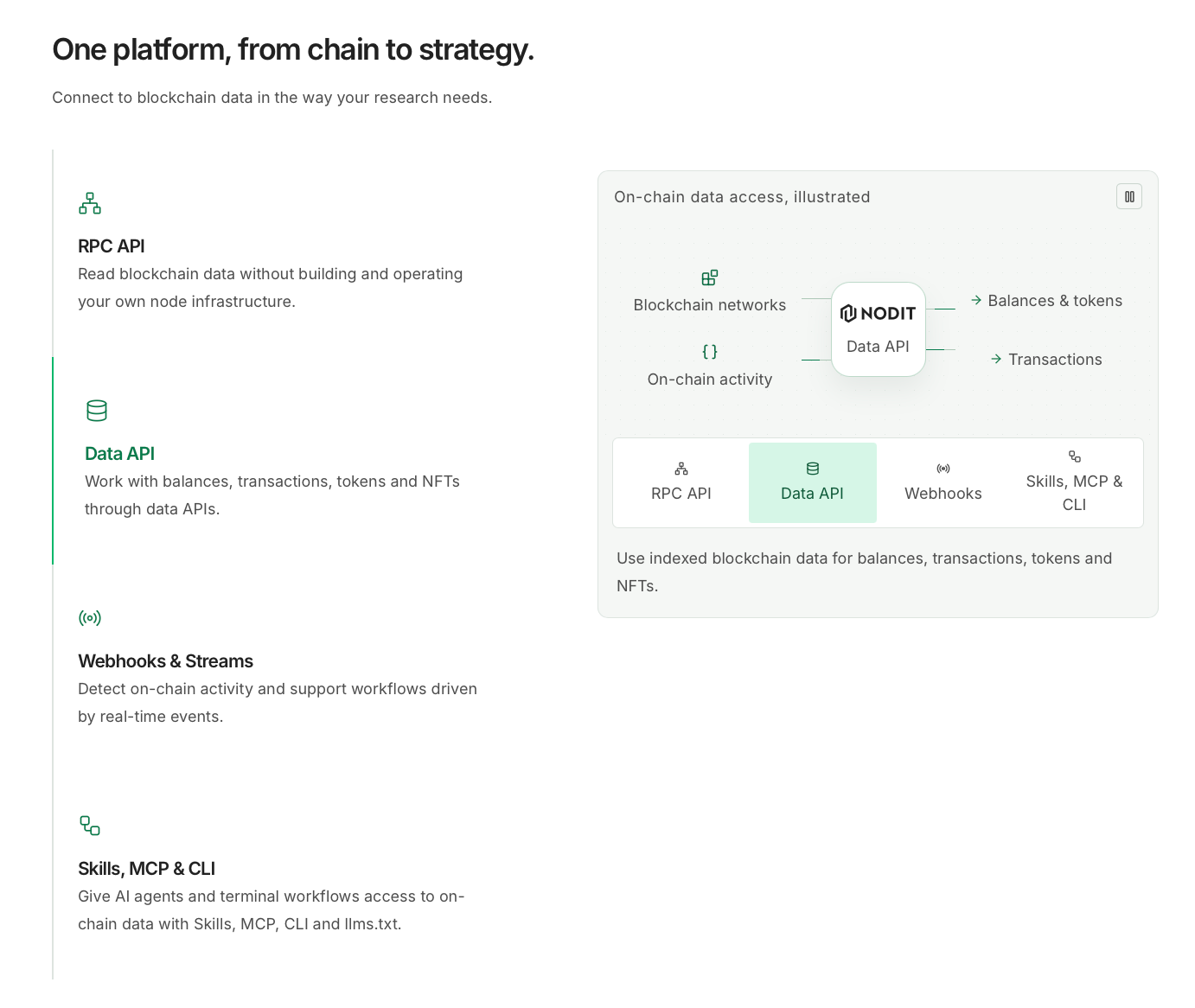
Effective monitoring begins with a clear view of asset holdings and movements. The Nodit Data API provides wallet balances, token holdings and transfer history on supported networks, reducing the need for teams to operate their own nodes or maintain custom indexing infrastructure.
Teams can integrate this data through several interfaces, according to their operational requirements:
- AI-assisted research: Nodit MCP enables compatible clients, including Claude Desktop and Cursor, to access supported Nodit APIs. An analyst could use an AI client to retrieve transfer records for selected wallets and calculate net token flows over a defined period. This workflow requires appropriate handling of pagination, token units and calculation logic. Nodit Skills also support API access through compatible coding agents such as Claude Code.
- Command-line workflows: Nodit CLI provides command-line access to supported RPC, Data, Webhook and Stream operations, supporting integration with scripts and automated workflows.
- Direct application integration: Teams can connect Data API and RPC endpoints to their research pipelines, analytics applications and internal monitoring systems.
These interfaces allow teams to incorporate on-chain data into existing processes using the tools appropriate to their environment.
2. Event-Driven Risk Monitoring
Timely visibility into asset movements supports established risk management processes. Nodit Webhooks and Streamprovide complementary methods for delivering relevant on-chain events to internal systems.
Webhooks support defined event notifications. When a configured event occurs, Nodit sends an HTTP request to the designated endpoint, with automatic retries for temporary delivery failures.
Potential applications include monitoring:
- Transfers exceeding a team-defined threshold.
- Token receipts that require review against an approved asset list.
- Specific event logs emitted by monitored smart contracts.
Teams define the relevant conditions through supported Webhook configuration options or apply classification rules within their own systems.
Stream supports continuous event ingestion. Through a persistent WebSocket connection, teams can subscribe to supported on-chain events and integrate the resulting data into dashboards, analytics pipelines or alerting systems.
Webhooks are suited to notifications triggered by defined events. Stream supports workflows that require ongoing event ingestion. Teams can use either approach or combine them according to their monitoring requirements. Available event types and network coverage vary by service.
Both capabilities provide inputs to the organization’s risk processes. Assessment, escalation and response remain governed by the team’s own policies.
3. Simplifying Research Infrastructure
Maintaining blockchain data infrastructure introduces operational work beyond the research itself. Teams must manage data retrieval, reconcile formats and address interruptions that may affect analysis or monitoring.
Nodit brings managed node access, indexed data APIs and event delivery into one platform. Standardized responses across supported Data API networks can simplify integration and reduce the need for separate processing logic for each network.
This approach helps teams reduce infrastructure maintenance and dedicate more resources to hypothesis testing, data validation and analytical development.
Monitoring Fund Wallets in Practice
A fund or quantitative research team could combine these capabilities in the following workflow:
- Establish the monitoring scope. Identify relevant fund wallets, assets and smart contracts.
- Create a data baseline. Retrieve current balances and recent transfer records through the Data API, using direct integration, an MCP-compatible client or the CLI.
- Configure event delivery. Establish Webhooks for defined events and use Stream where continuous data ingestion is required.
- Apply internal risk controls. Evaluate incoming events against the organization’s thresholds, review procedures and escalation policies.
- Evaluate and refine. Compare recorded events with market data and subsequent outcomes to improve monitoring rules and research assumptions.
Nodit provides the underlying data access and event delivery. The team retains responsibility for analytical methods, risk decisions and execution.
Advancing the Application of On-Chain Data
The partnership with Fund Connect HK supports the practical application of on-chain data in quantitative research and digital asset monitoring.
By providing access to its infrastructure and developer tools, Nodit aims to help participating teams incorporate blockchain data into repeatable research and operational processes. We look forward to the approaches participants develop, from asset-flow analysis to event-driven risk monitoring.
Championship participants can visit the Nodit partner page for Developer Plan support.
Research and development teams can explore the Quickstart for AI and developer documentation for implementation guidance.
If your team is exploring onchain data for quantitative research, strategy development, or risk monitoring, we’d welcome the opportunity to discuss your needs.
About Nodit
Nodit is an enterprise-grade blockchain infrastructure platform providing reliable node access and consistent on-chain data for digital asset services. Across 70+ networks, Nodit combines managed node infrastructure, standardized data processing and real-time event delivery to support production-scale operations, institutional analytics, and AI applications.
SOC 2 Type I & II Certified and backed by proven experience with major regulated exchanges worldwide, Nodit provides the complete on-chain data pipeline that powers the digital asset economy.